Every afternoon around 3:00, Freebird rests.
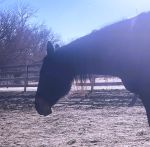
She doesn’t lie down. She simply softens.
Her head lowers. Her eye softens. Sometimes she yawns, long and slow. One back hoof tips forward, balanced lightly on the toe. Her breathing deepens. The sharp edges leave her body.
It’s subtle. You could miss it if you weren’t paying attention.
But I see it.
She is 12 this year.
For most of those 12 years, her nervous system has known something very different: high alert, hyper-vigilance, the constant scanning of an animal braced for impact.
Many of us know that posture.
Blow after blow, loss after loss. The body learns quickly: stay ready. Stay tight. Don’t let your guard down.
The hard part is not surviving that way.
The hard part is relearning how to rest.
Lately, I’ve made a quiet decision. I no longer tell Freebird’s trauma story. It belongs to her. It belongs to the past. And it is not the most important thing about her.
What feels more sacred is this:
-
She is in a space now where she is wanted.
-
Where she is told she is loved.
-
Where she is given room to be fully herself.
I tell her regularly that I want her here. Jamie tells her regularly that she wants her here. The people who spend time near her are kind and gentle, and they allow her to approach or step away as she chooses.
No one demands that she override her instincts.
No one rushes her process.
And in that consistency, something shifts.
A body that has lived in vigilance begins to experiment with letting go.
This is what I see at DreamCatchers.
People arrive carrying stories they may or may not choose to tell. Some have spent years bracing. Some don’t even realize how tightly they are holding themselves together.
We don’t force the story here.
We don’t search pain for proof of healing.
We create steadiness.
We offer space.
We let the nervous system take its time.
Healing, I am learning, often looks less like dramatic breakthroughs and more like:
-
A yawn in the afternoon sun.
-
A back hoof tipped forward.
-
A body deciding, even for a few minutes, “I can soften.”
Freebird’s rest is not small.
It is profound.
And if you are someone who has lived on alert for far too long, I want you to know this:
Your body is not broken.
It adapted.
And with enough love, consistency, and safety, it can adapt again.